The Weekly Wit 021
Week 21, 2023 A Curated Collection of Insights, Articles, Tools, Books, and Words to Expand Your Mind

Decision of Leaving a Job - Understanding the Expected Value Concept. Making Informed Decisions
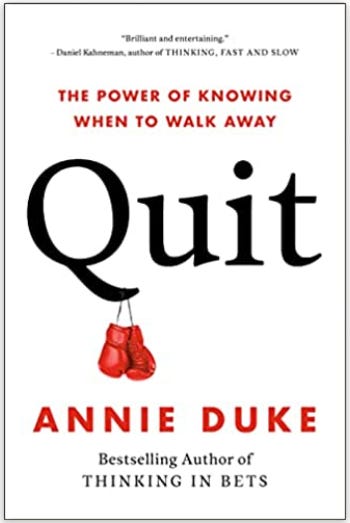
In my recent reading of the book "Quit" by Annie Duke, I came across the concept of expected value, which gives us a better understanding of decision-making process. "Quit" explores the intersection of decision-making, uncertainty, and risk, providing valuable insights into making better choices.
Annie Duke highlights the concept of expected value as a fundamental principle when it comes to evaluating options and weighing potential outcomes. The book delves into how expected value calculations can help individuals assess the risks and rewards associated with different decisions, ultimately guiding them towards more informed choices.
In the realm of decision-making, understanding the concept of expected value can be an invaluable tool. Whether you're assessing investment opportunities, evaluating business strategies, or making personal choices, grasping the concept of expected value empowers you to make informed decisions.
So, What is Expected Value?
Expected value is a mathematical concept that quantifies the average outcome or return of a decision or event. It combines the probability of each possible outcome with the value or utility associated with those outcomes. By calculating the expected value, individuals can evaluate the potential benefits and risks of a given decision, allowing them to compare and weigh their options.
Lets try to understand this by applying Expected Value to the Decision of Leaving a Job
Imagine you are considering whether to leave your current job and pursue a new opportunity. Utilising the concept of expected value can help you make a more informed decision by weighing the potential outcomes and their associated probabilities. Let's break down the decision-making process using expected value.
Step 1: Identify the Outcomes: Consider the potential outcomes of staying in your current job or leaving for the new opportunity. For simplicity, let's assume there are three possible outcomes:
Staying in the current job:
Outcome: Job stability, familiar work environment, average satisfaction.
Value (utility): Let's assign this outcome a value of 7 on a scale of 1 to 10.
Leaving the job for the new opportunity:
Outcome: Increased salary, career growth potential, excitement.
Value (utility): Let's assign this outcome a value of 9 on a scale of 1 to 10.
Leaving the job for the new opportunity, but it doesn't work out:
Outcome: Unemployment, financial stress, uncertainty.
Value (utility): Let's assign this outcome a value of 3 on a scale of 1 to 10.
Now,
Step 2: Determine the Probabilities: Next, assess the probabilities associated with each outcome based on your understanding of the situation. Again, for simplicity, let's assume the following probabilities:
Staying in the current job:
Probability: 0.6 (or 60% chance of this outcome occurring).
Leaving the job for the new opportunity:
Probability: 0.3 (or 30% chance of this outcome occurring).
Leaving the job for the new opportunity, but it doesn't work out:
Probability: 0.1 (or 10% chance of this outcome occurring).
Finally,
Step 3: Calculate the Expected Value: Using the formula for expected value i.e. Expected Value = (Outcome × Probability ).
Expected Value of staying in the current job: (7 × 0.6) = 4.2
Expected Value of leaving the job for the new opportunity: (9 × 0.3) + (3 × 0.1) = 2.7
Comparing the Expected Values:
In this scenario, the expected value of staying in the current job is 4.2, while the expected value of leaving for the new opportunity is 2.7.
Based on these calculations, it appears that staying in the current job has a higher expected value.
The expected value analysis suggests that, on average, staying in your current job may provide greater overall satisfaction and stability compared to taking the new opportunity. However, it's essential to remember that expected value calculations do not capture personal factors such as career aspirations, personal growth, or passion for the new opportunity.
Pebbles of Perception
The worst time to make a decision is when you’re “in it”
Check out some of my previous newsletters
Ikigai: Discovering Purpose, Passion, and Fulfillment in Life
From Order to Chaos: Understanding the Fascinating Concept of Entropy
How the Pursuit of Corporate Success Can Leave Us Emotionally Bankrupt
As always, if you found value in the content I've shared, please consider sharing it with your colleagues, friends, and family members who may also benefit from it. And if you haven't already, don't forget to subscribe to the newsletter to stay updated on our latest insights, articles, tools, books, and words to expand your mind.